
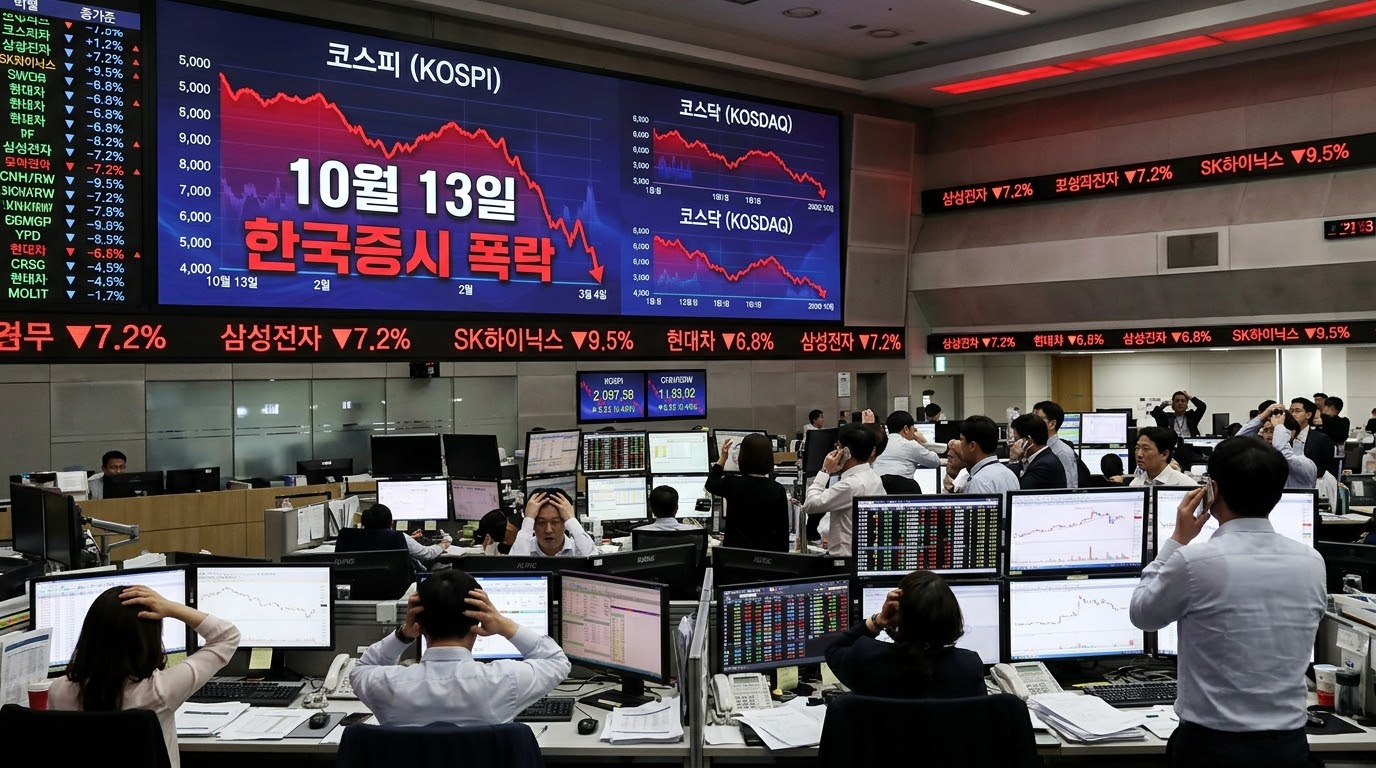
South Korea’s stock market suffered a sharp fall on October 13 as investors sold shares in major technology companies. Samsung Electronics and SK Hynix led the decline, raising concerns about growing competition in the semiconductor industry and the future of artificial intelligence (AI) spending.
KOSPI Falls More Than 5%
South Korea’s benchmark KOSPI index closed at 6,035.35 points, down 5.46% from the previous trading session. During the day, the index fell as much as 7.41% before recovering some of its losses.
Foreign investors sold a net 4.53 trillion won (about US$3.4 billion) worth of shares listed on the KOSPI, putting significant pressure on the market.
The decline was one of South Korea’s sharpest market drops in nearly two months. Other Asian technology markets also came under pressure as investors became more cautious about semiconductor stocks.
Samsung and SK Hynix Lead the Decline
Samsung Electronics shares fell 7.39% to 232,000 won, while SK Hynix dropped 10.09% to 1,443,000 won.
Both companies are major players in the global memory chip industry. Their products are widely used in computers, smartphones and AI data centers, making their performance closely linked to demand for advanced computing technology.
The steep losses highlighted how quickly investor sentiment can change when expectations for the semiconductor industry become less certain.
Chinese Chipmaker Raises Competition Concerns
One concern was progress reported by Chinese memory chipmaker ChangXin Memory Technologies, also known as CXMT.
Reports about its work on a new memory-chip design raised questions about future competition in the global memory market. Investors are watching whether Chinese manufacturers could eventually challenge established suppliers and put pressure on prices and profit margins.
However, technological progress does not automatically mean a company can manufacture chips at a large scale or compete with established producers on equal terms. The timing and commercial impact of any new products remain important uncertainties.
Investors Question AI Spending
Concerns about competition were accompanied by growing questions about the cost of building AI infrastructure.
Companies worldwide have invested heavily in data centers, advanced processors and memory chips to support AI services. Investors are now paying closer attention to whether the resulting revenue and profits will justify that spending.
Higher financing costs and uncertainty about future returns have also added pressure to technology stocks. These concerns extend beyond South Korea, affecting semiconductor companies and other businesses connected to the AI industry.
What Happens Next?
The latest sell-off does not necessarily mean that demand for AI technology is disappearing. Instead, it shows that investors are becoming more sensitive to competition, financing costs and the potential returns from large technology investments.
For South Korea, the performance of Samsung Electronics and SK Hynix remains important because semiconductors are a major part of the country’s export industry.
Investors will be watching future earnings, AI-related demand and developments in China’s semiconductor industry to assess whether the market can recover.
Source: Reuters, October 13, 2026; Aju Press, October 13, 2026
Additional Sources: Seoul Economic Daily; ChosunBiz
Category: Business
Published: October 14, 2026