
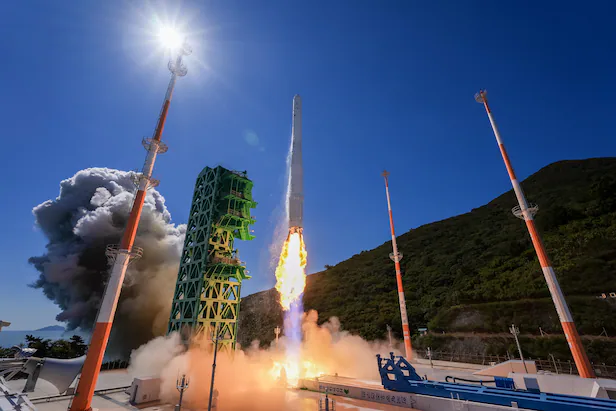
South Korea has successfully launched its homegrown Nuri rocket for the fifth time, marking another important step in the country’s growing space industry.
Nuri lifted off from the Naro Space Center in Goheung, South Jeolla Province, at 12:25 p.m. on October 7.
Five Satellites Successfully Deployed
The main mission was to place five NEONSAT microsatellites into orbit.
All five satellites, numbered NEONSAT 2 through 6, were successfully separated from the rocket at an altitude of about 575 kilometers.
The satellites are part of South Korea’s first domestically launched microsatellite constellation. They are designed to observe the Korean Peninsula and surrounding areas for national security and disaster response.
The five satellites were released one by one, about 35 to 40 seconds apart.
One CubeSat Failed to Separate
Nuri also carried 10 smaller CubeSats as secondary payloads.
Nine of them were successfully released, but one satellite, PERSAT-02, failed to separate from the rocket.
Despite this, the main mission of deploying the five NEONSAT satellites was completed successfully.
A New Step for Korea’s Space Industry
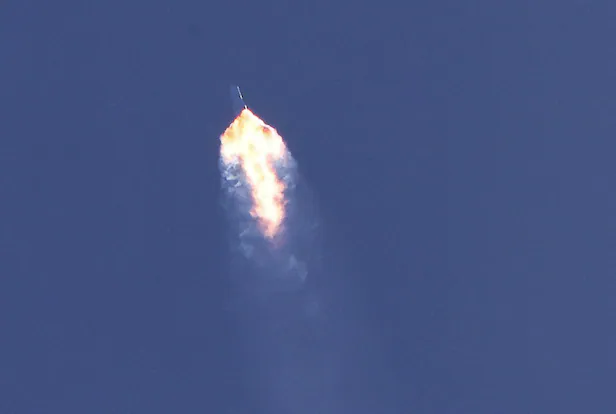
The fifth Nuri launch was important because it was the first time the rocket deployed several satellites designed to perform the same mission.
The five NEONSAT satellites will eventually become part of a larger constellation of 10 satellites. The remaining five are scheduled to be launched on Nuri’s sixth flight in the second half of 2027.
Once the full constellation is operating, the satellites are expected to be able to observe the Korean Peninsula more than three times a day.
Nuri Is Becoming More Reliable
This was Nuri’s fifth launch and its fourth consecutive successful mission after its first launch failed in 2021.
The latest success raises Nuri’s overall launch success rate to 80 percent.
It also shows how South Korea is gradually moving from a government-led space program toward a space industry involving more private companies.
Source: Korea AeroSpace Administration (KASA), October 7, 2026
Additional Sources: Yonhap News Agency
Category: Society
Published: October 8, 2026